The recent European Championships was one of the greatest football tournaments of recent years. The standard was good, there were only a handful of dull games, some truly memorable ones, while in general, it is fair to say that open and attacking football dominated. The tournament lived up to the hype, and despite the fact that the pressure, scrutiny and stakes increased exponentially with each successive round, it concluded satisfactorily in the eyes of most fans.
Almost.
The Henri Delauney trophy is a horrible thing. It does not do justice to the magnitude of the tournament which it embodies. I cannot help but feel that the great captains who have lifted the trophy, such as Giacinto Facchetti, Jurgen Klinsmann, Franz Beckenbauer, Michel Platini, and most recently Iker Casillas, must have been incredibly underwhelmed whilst doing so. It is an average sized pot with freakishly small handles rather bizarrely located on the top of the trophy. There is nothing solid to hold onto for that victorious thrust to the heavens after the trophy is handed over. Simply put, it is not a good ceremonial piece.
Bearing this in mind, one naturally begins to wonder what makes a good trophy. There are a number of key components:
The Bigger the Better:
As Renault's advertising people have been telling us for years, size matters. When it comes to trophies, bigger really is better. The canons of good taste go out the window in this matter - for the biggest tournament in a given sport, you need something obscenely oversized. UEFA had the right idea with the European Cup. Real Madrid were allowed to keep the original trophy having won their sixth title in 1966, and the new design more than adequately summed up what the tournament should be all about - ostentatious excess. You know you've hit the pinnacle of your sport when the trophy requires two men to lift. Huge arms facilitate this, and just scream out "Lift me up and parade me." This is a good thing.
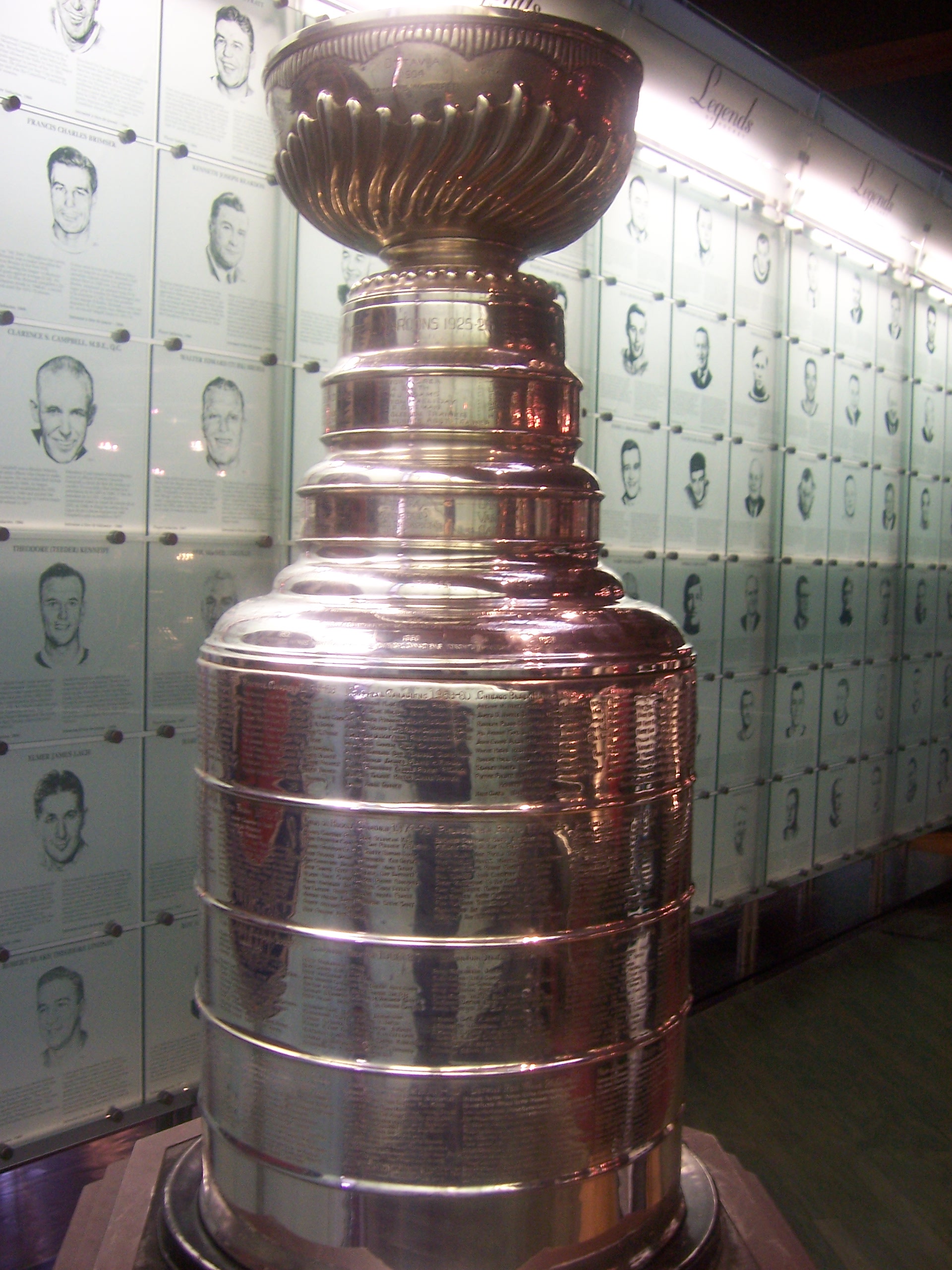
As the great Danny Kelly once remarked, trophies in the big tournaments should resemble something that you have bought at B+Q, requiring a trolley of some sort so that it can be wheeled from place to place. The NHL have the right idea in this regard, and the Stanley Cup conveys all the grandeur and over the top showboating that should come with being the best team in hockey. Being able to cradle a trophy, such as the World Cup, is not appropriate given the stage. Ostentation ostentation ostentation. A tournament should have its importance underlined by the size of the trophy, with a sliding scale existing for the lesser tournaments. As much as the history of the Ashes trophy is to be lauded, they really need a much bigger pot. However, this line of phallic argument may not translate to women's sports.
Simple is Good:
A simple trophy is a good trophy. There is no greater sin than creating a trophy that aspires to make an artistic statement, especially if this is rooted in the prevailing trends of the day. A great example of this is, of course, the FIFA World Cup. A new trophy was designed for the 1974 tournament as Brazil were allowed to keep the original design having won the competition for the third time in 1970. The new design is well and truly stuck in a horrid 1970s timewarp, and was most memorably recreated by Frank Skinner on Fantasy Football League, when he produced an uncanny likeness by grabbing an orange in his hand, dipping both fruit and arm into a bucket of custard, then parading the results. The World Cup is only somewhat redeemed by the fact that it is made of solid gold.
The Premier League trophy, created with the inception of the new league in 1992, embodies all the fireworks-and-cheerleaders glitz that came with the arrival of Sky TV on the scene. Gaudy gold lions and a tacky looking removable crown might be just the tonic for an under-fourteen provincial league, but not for the self-styled best league in the world. In addition, is it me, or did the Premier League also usher in the era of the contrived group bounce when posing for photos after the presentation of the trophy? Do people really bounce spontaneously at such times? I have my doubts.
In baseball, the World Series trophy, first awarded in 1967, is a ridiculously elaborate piece which eschews the traditional big-pot/solid-chunk-o-gold duopoly, and instead boasts pennants representing each team in the sport [currently at thirty] mounted onto a solid base. It is the sort of piece that once cannot get a good grip on, and secondly, would surely lead to fears of snapping off the constituent parts at the slightest hint of rough handling. By way of contrast, the venerable Stanley Cup can handle some rough drunken revelry and still come out at the other side in one piece. Seinfeld's George Costanza had the right idea when he tied the World Series trophy to the back of his car and drove around the parking lot at Yankee stadium in a deranged moment of protest.
Trophies should stand for something:
Trophies should be awarded in big tournaments that mean something. Is there really any need to cobble together second rate jugs for pre-season competitions or friendly internationals? In late 2006, the Welsh Rugby Union team met Australia in Cardiff in a test match. This was sponsored by Invesco, who, in order to maximise their exposure, gave the match a title [The First Invesco Perpetual Cup!], and had a trophy prepared for the winners. The only hitch with their plan was that the game ended in a pulsating 29-29 draw, good publicity in its own right, but rather embarrassing when they insisted on presenting the trophy anyway to the two rather sheepish looking captains, complete with fireworks being launched and the obligatory tickertape explosion on the pitch. I repeat: this was for the Invesco Perpetual Cup. It is not exactly the stuff of dreams.
Some other ground-rules in trophy production:
1) The best trophies are simple but multi-functional, and usually double as kitchen utensils: you can either eat off of them [see the Charity Shield or the Wimbledon women's trophy] or drink out of them [the Stanley Cup again]. This is good.
2) The best trophies are difficult to lift.
3) Removable constituent parts are a bonus. Using the lid of the FA Cup as a hat is as much a part of that competition as are the phrases 'magic of the cup' and 'plucky underdogs.'
[Updates are sure to follow]




No comments:
Post a Comment