Tuesday, July 29, 2008

The Chinese Authorities Clamp Down


We are often told that they should not, but, of course, politics and sport frequently do mix, and when they do, it can make for delicious talking points. There are too many examples that spring to mind of the obsession of a national leader with a given sport that often outstrips their preoccupation with more pressing matters: see Fidel Castro and baseball, or General Franco and his love of Real Madrid, or closer to home, those of us in Ireland had the misfortune to see former Taoiseach Bertie Ahern appear as a guest analyst on the Premiership on RTE [and doesn't it just feel great typing the words 'former Taoiseach Bertie Ahern'? I digress].

In China, of course, many Western websites such as BBC.com or CNN.com are inaccessible, and certain keyword searches for politically sensitive issues will yield no fruit either. However, a reporter from the Rocky Mountain News in Colorado, currently in Beijing to cover the Olympics, discovered that other more surprising sites are inaccessible too, with the oddest of these being Firejoemorgan.com.

Fire Joe Morgan is a blog which satirises the cliched culture of sports reporting in the United States [not just a British phenomenon], with a particular emphasis on baseball. The authors, some high profile comedy writers currently based in Los Angeles, are proponents of a sabermetric approach to baseball statistics, putting emphasis on the analysis of new statistics which more accurately describe a player's value [offensive or defensive production, or contribution to wins, etc] in different scenarios. This is opposed to the scrutiny of traditional statistics such as Runs Batted In, Batting Average, or Pitchers' Wins, part of baseball lore but woefully ineffective in accurately describing the performance of players in helping their teams win, or accomplishing the tasks set before them.

Naturally, a sabermetric approach tends to be completely at odds with the majority of baseball writers who peddle hackneyed cliches and are purveyors of crude and ineffective analysis. So the writers at Fire Joe Morgan savage them, hilariously and mercilessly [the website name comes from the leading 'analyst' for national sports broadcaster ESPN, who every week (for almost a decade) does a live chat on the ESPN.com website, where he tries his best to avoid answering questions from the public. Seriously].

The question then is this: are the Chinese authorities baseball traditionalists? In this increasingly deep and bitter schism between [crudely speaking] established newspaper writers and statistically aware bloggers, has the ruling party decided to take a decisive stance in favour of the former? We need to know.

Monday, July 28, 2008

A Cruel Joke


The BBC's main football page today boasts some very dark humour. For those of you who don't get this reference, see here.

Sunday, July 27, 2008

More Transfer Hyperbole

The Observer tells us that Kaka is the '£1m per month man' in their lead sports story. So, what is their scoop? Their 'scoop' is one of the more oddly constructed paragraphs you will read. Well it would be were this not the world of lazy hack gossip mongering.

Kaka, the World and European Player of the Year, is likely to become the first £1m-a-month footballer if Chelsea manage to sign the Milan midfielder, who 'is of interest to the club', executives at Stamford Bridge confirmed last night.

One more time:

Kaka, the World and European Player of the Year, is likely to become the first £1m-a-month footballer...

He is likely to do this deal. News! Great! Finally, something newsworthy in a slow summer for transfers!

...if Chelsea manage to sign the Milan midfielder...

If they manage to sign him? But they will, won't they? Tell me they will! A deal is happening! Surely they have made a bid! Has it been accepted? Are negotiations ongoing? Yes?

...who 'is of interest to the club', executives at Stamford Bridge confirmed last night.

Right. So the scoop is that executives at Chelsea reckon that Kaka is 'of interest' to them. Is this news? Is there any team that can legitimately claim that Kaka is not 'of interest' to them? Seriously - where is the meat in this story?

Trophy Strife

The recent European Championships was one of the greatest football tournaments of recent years. The standard was good, there were only a handful of dull games, some truly memorable ones, while in general, it is fair to say that open and attacking football dominated. The tournament lived up to the hype, and despite the fact that the pressure, scrutiny and stakes increased exponentially with each successive round, it concluded satisfactorily in the eyes of most fans.

Almost.

The Henri Delauney trophy
is a horrible thing. It does not do justice to the magnitude of the tournament which it embodies. I cannot help but feel that the great captains who have lifted the trophy, such as Giacinto Facchetti, Jurgen Klinsmann, Franz Beckenbauer, Michel Platini, and most recently Iker Casillas, must have been incredibly underwhelmed whilst doing so. It is an average sized pot with freakishly small handles rather bizarrely located on the top of the trophy. There is nothing solid to hold onto for that victorious thrust to the heavens after the trophy is handed over. Simply put, it is not a good ceremonial piece.

Bearing this in mind, one naturally begins to wonder what makes a good trophy. There are a number of key components:

The Bigger the Better:

As Renault's advertising people have been telling us for years, size matters. When it comes to trophies, bigger really is better. The canons of good taste go out the window in this matter - for the biggest tournament in a given sport, you need something obscenely oversized. UEFA had the right idea with the European Cup. Real Madrid were allowed to keep the original trophy having won their sixth title in 1966, and the new design more than adequately summed up what the tournament should be all about - ostentatious excess. You know you've hit the pinnacle of your sport when the trophy requires two men to lift. Huge arms facilitate this, and just scream out "Lift me up and parade me." This is a good thing.

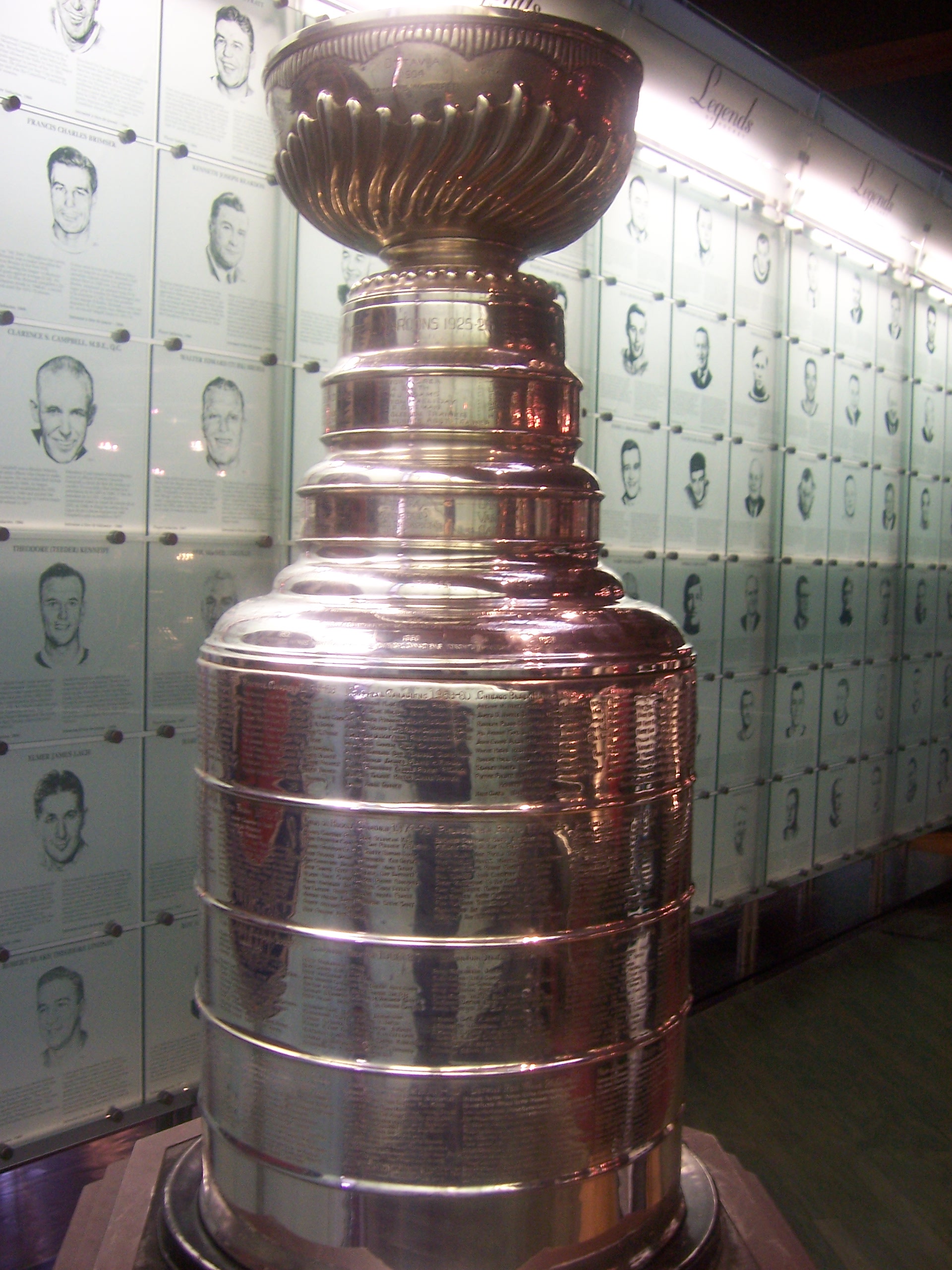
As the great Danny Kelly once remarked, trophies in the big tournaments should resemble something that you have bought at B+Q, requiring a trolley of some sort so that it can be wheeled from place to place. The NHL have the right idea in this regard, and the Stanley Cup conveys all the grandeur and over the top showboating that should come with being the best team in hockey. Being able to cradle a trophy, such as the World Cup, is not appropriate given the stage. Ostentation ostentation ostentation. A tournament should have its importance underlined by the size of the trophy, with a sliding scale existing for the lesser tournaments. As much as the history of the Ashes trophy is to be lauded, they really need a much bigger pot. However, this line of phallic argument may not translate to women's sports.

Simple is Good:

A simple trophy is a good trophy. There is no greater sin than creating a trophy that aspires to make an artistic statement, especially if this is rooted in the prevailing trends of the day. A great example of this is, of course, the FIFA World Cup. A new trophy was designed for the 1974 tournament as Brazil were allowed to keep the original design having won the competition for the third time in 1970. The new design is well and truly stuck in a horrid 1970s timewarp, and was most memorably recreated by Frank Skinner on Fantasy Football League, when he produced an uncanny likeness by grabbing an orange in his hand, dipping both fruit and arm into a bucket of custard, then parading the results. The World Cup is only somewhat redeemed by the fact that it is made of solid gold.

The Premier League trophy, created with the inception of the new league in 1992, embodies all the fireworks-and-cheerleaders glitz that came with the arrival of Sky TV on the scene. Gaudy gold lions and a tacky looking removable crown might be just the tonic for an under-fourteen provincial league, but not for the self-styled best league in the world. In addition, is it me, or did the Premier League also usher in the era of the contrived group bounce when posing for photos after the presentation of the trophy? Do people really bounce spontaneously at such times? I have my doubts.

In baseball, the World Series trophy, first awarded in 1967, is a ridiculously elaborate piece which eschews the traditional big-pot/solid-chunk-o-gold duopoly, and instead boasts pennants representing each team in the sport [currently at thirty] mounted onto a solid base. It is the sort of piece that once cannot get a good grip on, and secondly, would surely lead to fears of snapping off the constituent parts at the slightest hint of rough handling. By way of contrast, the venerable Stanley Cup can handle some rough drunken revelry and still come out at the other side in one piece. Seinfeld's George Costanza had the right idea when he tied the World Series trophy to the back of his car and drove around the parking lot at Yankee stadium in a deranged moment of protest.

Trophies should stand for something:

Trophies should be awarded in big tournaments that mean something. Is there really any need to cobble together second rate jugs for pre-season competitions or friendly internationals? In late 2006, the Welsh Rugby Union team met Australia in Cardiff in a test match. This was sponsored by Invesco, who, in order to maximise their exposure, gave the match a title [The First Invesco Perpetual Cup!], and had a trophy prepared for the winners. The only hitch with their plan was that the game ended in a pulsating 29-29 draw, good publicity in its own right, but rather embarrassing when they insisted on presenting the trophy anyway to the two rather sheepish looking captains, complete with fireworks being launched and the obligatory tickertape explosion on the pitch. I repeat: this was for the Invesco Perpetual Cup. It is not exactly the stuff of dreams.

Some other ground-rules in trophy production:

1) The best trophies are simple but multi-functional, and usually double as kitchen utensils: you can either eat off of them [see the Charity Shield or the Wimbledon women's trophy] or drink out of them [the Stanley Cup again]. This is good.
2) The best trophies are difficult to lift.
3) Removable constituent parts are a bonus. Using the lid of the FA Cup as a hat is as much a part of that competition as are the phrases 'magic of the cup' and 'plucky underdogs.'

[Updates are sure to follow]

Sunday, July 20, 2008

A Dangerous Precedent

As has been reported in a number of places, St. Pats' midfielder Michael Keane was 'sacked for being too fat.' Keane was one of the club's highest earners, and had apparently been issued with an ultimatum earlier in the season regarding his physical condition, which he chose to disregard. Evidently the pull of a good meat pie was more appealing than that of playing at a (probably) windswept Dalymount Park.

This decision is nothing short of a disgrace. For many years now, larger athletes have brought excitement, skill, and no little girth to top level sport (and also to substandard sport). Surely there is something to be celebrated in the man who eschews training sessions in favour of pints, the local nightclub, and a kebab, and can still maintain a high level of sporting performance the following day? With that in mind, let's review the achievements of some true sporting icons who did not conform to the tyranny of regular training sessions, healthy diet, and a general concern for the wellbeing of their teams.

Nigel Mansell, Formula One:

Type the words 'Nigel+Mansell+Fat+McLaren' into google and it helpfully suggests that perhaps you meant 'Nigel+Mansell+Fast+McLaren.' No sir, that is not what I meant at all. Mansell is one of the all time great Grand Prix drivers, boasting one World Championship (1992) and 31 career wins. However, the real reason for Mansell's inclusion on this list is his impressive girth which meant that he was unable to fit into his 1995 McLaren. To embarrassment all round, the car had to be redesigned to accommodate his posterior. Still, that's star value for you. You can't tell a man with such a distinguished track record to lose weight now, can you?

Ferenc Puskas, Football:

Puskas, known as the 'Galloping Major', is one of the all-time great footballers, who played for two of the most accomplished teams ever assembled: the Hungarian team of the early 1950s which won the Olympics in 1952 and were World Cup finalists in 1954, and also the Read Madrid team which beat Eintracht Frankfurt 7-3 in the European Cup final of 1960. Make no mistake, Puskas was fat. When the Hungarian team showed up to train at Wembley in advance of their game with England in 1953, a number of the home team's players, not knowing who Puskas was, laughed at 'the little fat chap.' Of course, Puskas went on to orchestrate England's demolition (6-3, then 7-1 in the return game) and became one of the dominant footballers for the next decade. Point is, if you're good enough, who needs to stay in shape?

Jan Ullrich, cycling:

Jan Ullrich won the Tour de France in 1997, and finished second five times. His career achievements would have been greater were it not for the dominance of Lance Armstrong. Ullrich had chronic issues with his weight throughout his career, and used to starve himself in advance of big events to reach his desired weight. None of this sensible training malarkey for him. Ullrich's attitude to his own physical condition was admirable. His explanation of a failed (out of competition) drugs test in 2002 was that he had gone out on the batter and taken two ecstasy pills. Nothing performance enhancing going on here, folks.

Babe Ruth, baseball:

The Bambino was not only one of the greatest players in the history of the sport, but he also utterly transformed the way the game was played, hitting unprecedented numbers of home runs in the 1920s, and bringing huge crowds through the turnstiles. Ruth was arguably the first sporting celebrity. His success was based on excess. Ruth's physique was hardly that of the elite athlete, and the stories of his binging are legendary. One has it that he once ate twenty four hot dogs between games of a double-header. On a train ride in April 1925, Ruth blacked out, having gorged himself on up to eighteen hot dogs, and later wound up in hospital. Some accounts have attributed the latter to gonorrhea, but whichever way you look at it, the man knew how to enjoy himself, while becoming a sporting icon at the same time.

John Daly, golf:

Daly was one of the top golfers of his day, but his career is more remarkable for his attitude to diet. He regularly smoked two packets of cigarettes a day, scoffed innumerable packets of M+Ms, made endless trips to McDonalds, and knew how to put away a beer or two into the bargain. For all this, Daly has managed five PGA tour wins, including the British Open in 1995. Kudos.

I could go on here, but the point should be clear. There has always been a place for those with a more 'liberal' attitude to their personal condition to thrive in elite sports. Unless it is something which adversely affects one's performance, weight and conditioning should not be an issue. For example, see the way the media routinely trots out the terms 'burly', 'unorthodox' and 'hefty' when describing Sunderland and Ireland midfielder Andy Reid. Sure, he looks a little different from many footballers [I attribute this to his ... uh ... dynamism] but when you are the best player at your club, snide comments should cease. Andy Reid is pulling his [considerable] weight for Sunderland.

Weightier athletes bring a lot to the sporting world. A lot of pies, burgers, hot dogs, booze, and of course, a lot of M+Ms. And for that, the sporting world is undoubtedly a healthier place. If sport occasionally emulates art, and if art imitates life, then it stands to reason that sport should imitate life, and life is, as we know, all about pie consumption. St. Patrick's Athletic should be ashamed of themselves for setting this dangerous precedent in sacking Michael Keane.

Wednesday, July 16, 2008

Predictable Headlines, Part II


Following on from the predictable headlines that follow Tyson Gay's escapades, the Guardian today unleashed a picture/headline combination which they had presumably been sitting on for months, nay, years.

Obviously, a suitable pretext was required to run with the 'Berbatov fumes' line. His potential move to Man Utd had to suffice. This, despite the problem acknowleged within the story itself, that: 'Berbatov has so far refused to agitate in public for a transfer. Although his agent, Emil Dantchev, has voiced his client's desire to play at club football's top level, Berbatov has betrayed his frustrations only through his body language, which at the beginning of last season in particular was lethargic.'
So, no real evidence at all then to suggest that The Berb is currently 'fuming', especially given the general unreliability of football agents. But we can't let this get in the way of a good headline. Bonus points for the 'drag out' part. Kudos to the Guardian!

Saturday, July 12, 2008

How Many People Actually Think That Pele is Sane?


From the BBC website comes a report that Pele has urged Cristiano Ronaldo to honour his contract at Man Utd. Not particularly newsworthy in itself, as Pele was in England anyway and was most likely harassed by reporters to say something on the issue. From the BBC report however, it is not entirely clear whether the reader is expected to take his comments seriously at all. See the wacky picture which accompanies said story, depicting Pele as what would be described in certain parts of Ireland as a head-the-ball.

And perhaps this is all well founded. Pele's high profile gaffes are many. In the early nineties he tipped one Nii Lamptey to be the next great player. In the run up to the World Cup in 1994, he was vocal in picking Colombia to win the tournament. They did not even make it out of the group stages, and their campaign will be remembered most for the murder of full back Andres Escobar.
While he was at it, the great one also made the bold prediction that an African side would win the World Cup by the year 2000, which of course, did not happen.

Pele is also a fully paid up member of the Too-Much-Information club. Nobody needed to know how he felt about losing his virginity: "I was scarcely 14. But let's be fair, it just wasn't my thing. It was with a homosexual that all our team used to go out with." Similarly, we do not want to hear him gush [pun, intended] about Viagra. But he does.

Given all this, it is perhaps understandable that people are reluctant to take everything that Pele says seriously. Still, does he really need to be depicted as an absolute loon?

Friday, July 11, 2008

Big Minnows

For the smaller teams of Europe, these are interesting times. A European qualifying campaign which began with Germany thumping San Marino 13-0 sparked a number of appalled analysts to bemoan the fact that such no-hopers were even permitted to take to the same pitch as the two-time world champions. Stern-faced pundits concurred that the already endangered value of international football would continue to be eroded by FIFA's insistence on allowing sides like San Marino (then ranked ten places below Tahiti) a seat at the table, their only hope of influencing the outcome of the group being the difference in goals conceded between each hammering. Earnest talk about setting up a pre-qualifying mini-league of minnows was indulged in, with the winners going on to compete with the bigger boys in the qualification campaign proper. Some Irish dailies took to printing an altered group table, sans the Sammarinese, factoring in the six points they would concede that were taken for granted from every double header. Patronising? Yes. Justified? Well, not if you're Irish. A few months after being turned over by the Germans, San Marino were drawing 1-1 with Ireland, courtesy of Manuele Marani's 87th minute equaliser. A goal with the last kick of the game spared the Irish what would have been their worst ever result, although in many ways it was already that. San Marino, however, emerged with something the commentariat had deemed them incapable of retaining: their pride. They went on to hold Wales to the same scoreline.

The minnows of Europe have been steadily on the rise, though attention is rarely paid to their progress. Cyprus - or, to be correct, the Greek half of Cyprus - finished the last qualification campaign having hammered Ireland and Wales (scoring eight goals in two games) as well as securing creditable 1-1 draws against Ireland away and Germany at home. Georgia comfortably beat an in-form Scottish side 2-0 in Tblisi, effectively ending the Scots' hopes of qualification. In 2005, Lichtenstein drew 2-2 with a Portugal side containing Cristiano Ronaldo, Luis Figo and Pauleta, while 2004 saw Latvia compete at the finals stage of their first ever major championships in Euro 2004. The phenomenon of Macedonia as perennial spoilers of Irish and English plans has been a lesson sorely learned in these parts, while the heroics of David Healy in memorable victories over England, Spain, Denmark and Sweden made Northern Ireland the biggest underdog story of recent years. While it would be an exaggeration to talk up these feats as a representing a wholesale shift in the European order, neither can they be dismissed as a mere series of once-offs. The weak teams are getting stronger - and the whole concept of what a 'minnow' is in footballing terms is being redefined.

Those of us old enough to remember the World Cup qualifying campaigns of the 1990s will recall the days when minnows were minnows and knew their place. Stumbling, blinking into the daylight after decades subsumed under the pall of Communism, satellite states and Balkan republics like Albania, Estonia, Latvia, Lithuania and Georgia were for most of their early existence the whipping boys of Old Europe. They were joined at the bottom of the barrel by new statelets such as Andorra, Lichtenstein and San Marino, with far-flung 'new nations' (with dubious claims to Europeanhood) such as Azerbaijan, Kazakhstan and Armenia, swelling both the qualification groups and UEFA coffers with new membership fees. Heavy defeats being order of the day, however, all endured a rocky introduction to European football - although the novelty of being recognised as independent states, with representative players, flags and anthems was not quick to wear off. The passion and pride of the eastern European and Balkan teams, spurred on by the ferocious conviction of their supporters, began to ask some uncomfortable questions of the more established sides, with their cossetted, comfortable big-league stars. Slowly but surely, the hammerings became hard-fought victories. The walk in the park become work in the park. Winning margins narrowed. The favourites began to leak goals. The 'tricky away tie' was born.

Success is relative when you're expected to lose every game - and a few moments of hope or glory on the pitch, however short-lived, were triumph in their own right. The most celebrated example is probably Davide Gaultieri who famously gave San Marino the lead 8.3 seconds into their final World Cup qualifier against England in 1993. The Sammarinese goal, apart from being a spectacular occurrence in its own right, had the double significance of meaning the English side had to score eight and hope that Poland beat the Netherlands in order to qualify (neither event came to pass). While Graham Taylor's sorry tenure as England manager did not last a game longer, it would be a mere two years until the obstinancy of another European minnow ultimately put paid to an English manager's reign.

With the automatic qualification spot at the top of the group seemingly at their mercy after a 1-0 home win against Portugal, Jack Charlton's Ireland team headed for Eschen, a ramshackle sports ground high in the Austrian Alps, to take on Lichtenstein - a side they had beaten 4-0 a few months beforehand. No doubt expecting more of the same and coming as it did at the end of the English season, the Irish started lethargically, with whatever long-range efforts that did make it through the ten man Lichtenstein defence being comfortably dealt with by man-of-the match goalkeeper (and full-time schoolteacher) Martin Heeb. As the minutes ticked by and the expected breakthrough failed to materialise, Ireland suddenly found themselves at half-time with the score still 0-0. As the second half wore on with the scoreline unchanged, the ragged and desperate efforts of the Irish struck a stark contrast to an increasingly assured group of Lichtenstein players who were visibly growing in confidence by the minute and who - with every Heeb save, tackle from captain Marcus Oper and relieving counter attack by their one full-time professional footballer Mario Frick (who would have a goal disallowed against the same opposition in Vaduz during the following campaign) - were actually beginning to believe in themselves too. Tony Cascarino was booked for punching the ball into the net in the 85th minute, with dismayed commentator George Hamilton wringing his hands at the striker's 'desperate tactic, which says it all - Ireland just cannot put the ball in Heeb's net'. Within ten minutes, the Lichtenstein players were performing a lap of honour around the stadium after holding a team which had defeated Italy in a World Cup only a year before. Ireland and Jack Charlton slunk away with a queasy sense of doom that the rot had started, and indeed it had: their self-belief irreparably damaged after Lichtensetein, defeats to Portugal and Austria followed and automatic qualification was forfeited. A limp playoff defeat to the Dutch at Anfield finally brought the curtain down on Charlton's Irish adventure, with press post-mortems unanimously pointing to the draw in Eschen as the decisive turning point. Whether it was that the minnows were not to be underestimated, or more that Ireland were no longer to be overestimated, nobody was quite sure. But whatever way you looked at it, for Ireland and Lichtenstein at least, something momentous had happened. Something had changed.

Gaultieri and Heeb are far from being the only heroes that minnow teams can point to, however. In perhaps the most celebrated minnow performance of modern times, the Faroe Islands beat Austria in their first ever competitive match in a qualifier for the 1992 European Championships. The Austrians - who counted legends Toni Polster, Andreas Herzog and Michael Konsel among their number - had returned from competing at the 1990 World Cup earlier in the summer and were managed by one Josef Hickersberger, in his first game as national coach. Much to the horror of Austrian football fans, however - and to the astonishment of everyone else - Torkil Nielsen's 61st minute goal gave the Faroes a 1-0 victory, sending the Danish archipelago into ecstasy and Hickersberger into immediate retirement after only one game (he subsequently re-emerged to coach the Austrians in this summer's Euros, having had eighteen years to recover from the embarrassment in Torshavn). While the Faroes have subsequently failed to recapture the spirit of 1990 with a string of defeats in the intervening years, they did at least come close when playing the forlorn Berti Vogts's Scotland in 2003, taking a 2-0 lead only to be pegged back to a final score of 2-2. A draw maybe, but still another scalp from the establishment.

While the Faroes have Nielsen and San Marino have Gaultieri, their fellow minnows are not without their own goal-getting heroes who - however briefly - put the frighteners on the bigger sides. It is with regrettable ease that I, as an Irish fan, can trace most of these goalscoring feats to the occasions when the smaller sides met Ireland - and the list is long. Pyrenéean principality Andorra came to Lansdowne Road in a World Cup qualifier in 2001 to play a nervy Irish side missing Roy Keane and stunned the stadium into silence by taking the lead through Ildefons Lima. Although Ireland got back on level terms through Kevin Kilbane and went on to run out 3-1 winners, there was a stultifyingly awful five or ten minutes when the Lansdowne scoreboard read: Ireland 0 Andorra 1, with echoes of George Hamilton's "no, your eyes do not deceive you" during Ireland's 3-1 loss to Spain in '93 seeming to issue forth from the dark abysm of time through those surreal few minutes.

Macedonia, of course, scarcely need an introduction: although many Irish fans remain convinced to this day that Ireland's 3-2 humbling in Skopje was due less to Georgi Hristov's goalscoring, and more to a combination of George Hamilton's irresponsible fate-tempting ("there's number one!" crowed the RTÉ commentator after Alan McLoughlin had given Ireland a 7th minute lead, shortly before the two Macedonian penalties and Jason McAteer's red card) and the equally horrific neon-orange jerseys sported by Mick McCarthy's team that dark day. Whatever the explanation, the boys in orange failed to learn from their arrogance and in 1999 produced another spectacular feat of snatching a draw from the jaws of victory when, leading the Macedonians 1-0 through a Niall Quinn goal and cruising to automatic qualification for Euro 2000, allowed Goran Stavreski to head home a 92nd minute equaliser with the last attack of the game, forcing Ireland into another joyless playoff defeat, this time to Turkey. It would be five years until England fans encountered Artem Sakiri and learned to shudder at the sound of 'Macedonia'.

Albania, led by playmaker Edwin Murati (nicknamed 'the Maradona of the Balkans'), have caused their own fair share of mayhem in their encounters with more established sides - Irish fans will remember Tony Cascarino rescuing a late victory after Kushtna had equalised, not to mention an equally fortuitous 2-1 victory in 2003 under Brian Kerr, when a last minute Aliaj own-goal cruelly denied the Albanians a deserved away point to add to their 0-0 draw in Tirana. But is this less a case of a maturing school of minnows and more the gradual decay of once-proud footballing nations? The answer is not immediately straightforward, but seems to lie somewhere between these two extremes. England face into a group containing Andorra, Belarus and Kazakhstan, Scotland must deal with the Macedonians while Ireland face undoubtedly the toughest opposition of the lot with the dreaded Cyprus and Georgia as 4th and 5th seeds. And don't for a moment think that we've got off lightly with the bottom seeds either - the only reason Montenegro are where they are is because this is their first campaign as an independent nation and they haven't played any competitive matches in which to improve their UEFA ranking. Captained by Roma striker Mirko Vucinic and having recently swatted Norway aside 3-1 in a friendly, there will be much to concern Giovanni Trapattoni and his charges.

"There are no easy games at this level" proclaimed Steve Staunton in the build-up to the San Marino away game. We laughed then, but the progress of Europe's smaller footballing nations may yet prove him right.

It's A Funny Old Name...

For the discerning fan, watching international tournaments is much like hunting for creepy-crawlies in the garden. Both involve staring at a patch of grass for a prolonged period of time, yes, but in terms of lifting the rock of trivia and exposing all the bizarre life-forms that have existed under the radar for so long, it has few equals. Every tournament throws up new specimens that, were it not for the bright light of the international stage being shone on them, would otherwise have continued to ply their quiet, unassuming trade under the radar, anonymous to the wider footballing public. Obscure player names become household mantras for four brief weeks during the summer. As when collecting insects, it was rarely the biggest, flashiest one that tended to catch the eye but the most unusual, and Euro 2008 has been no slouch in throwing up double-entendred and innuendo-ridden names. Yuri Zhirkov (persistently pronounced as 'jerk off' by the panelists on Irish TV) and Razvan Rat both gave us more reason than usual to be vocal in our exhortations of Russia and Romania. Semih, the man who helped Turkey stand tall, is surely uniquely placed to follow in Pele's footsteps in endorsing some kind of male medicament in the coming years. In part-marvel, part-mirth, we repeat these names among ourselves, exhausting every possible pun several times over. Football has given us much, but this veritable conveyor-belt of funny names is surely its greatest gift.

Bearing this in mind - and wishing to honour in a special way the contribution of international tournaments to this lexicon of linguistic laughter - it has seemed proper to assemble in one place the 'best of the best', as it were. The plan is simple: create a fantasy tournament of players drawn from all four corners of the globe, bound together into different teams not on account of their country of origin, but by the common nature of their surnames. Much like the inaugural European Championships, we have humble beginnings - ten teams compose the first lot of finalists. This is probably best explained by examples. So without further ado, ladies and gentlemen, I give you the official pre-tournament guide to the 2008 5-a-Side World Cup of Peculiar Surnames:

Group A
TEAM 1: Eat-Me FC
In a veritable feast of football, this motley band of veterans will be keen to prove they're not past their sell-by date. Goalkeeper Giuseppe Tagliatella has allegedly been simmering in private over comments made by his rival for the Number 1 jersey, Mike Salmon, that the Italian won't stay strong when the heat is turned up. He can at least have confidence in his defensive cover, with South African stalwart Mark Fish and French World Cup winner Frank Lebouef forming a partnership trusted by in-flight catering companies the world over. The midfield spot is one that is hotly contested, with Horacio Carbonari and Patrik Berger both stirring it up in the press over the manager's preference for Youssouf Chippo. Up front, however, fans can look forward to the mouthwatering prospect of Massimo Maccarone providing his usual combination of style and substance - although how he will fare in the pressure-cooker atmosphere remains to be seen.
Celebrity fan: English cricketer, Graham Onions.

TEAM 2: Go-Ahead Legals
With such an array of talent at his disposal, it would be a crime if former Aston Villa manager Brian Laws fails to make it past the group stages. Ever the reasonable man, the (rebuttable) presumption is that he will choose to court controversy by picking an offence-minded side with no goalkeeper, so confident is he in his defence - having recently solicited the services of Arsenal utility player Johan Djour(ou)y to complement former Manchester United star Chris L-Eagles at centre back - both will strive to bar the way to goal. Completing the defence will be Welsh minor Gareth Bale, whose hard-working style has got his team out of jail on more than one occasion. 'One would need to be resident on the moon' not to know that legend will captain the side - however, with the ex-Manchester City great now in his sixties, the jury is out on his fitness. Completing the line-up will be Shola Ameobi-lookalike Carl Cort, who - under Laws - has cultivated a reputation of spending a lot of time appealing for penalties in the box. This regrettable habit aside, the ex-Newcastle man's ability to hold things up means the Go-Ahead Legals will aim to go to Cort at every opportunity. Without a strong presence on the bench, however, expect defensive solidity to take precedent.
Celebrity fan: rugby union referee, Joel Jutge.

TEAM 3: Body Parts United
With the only squad to report an entirely clean bill of health, former Ireland manager Eoin Hand has every reason to have confidence in his current body of players. Despite fierce competition from Swedish goalkeeper Magnus Hedman, it is likely that German veteran Hans-Jorg Butt will occupy his position at the rear. Hand's defensive selection is anyone's guess however, with Sunderland reject Ian Harte likely to be deployed slightly to the left of the centre alongside one of Eirik Bakke or Danny Higginbottom, although Welsh veteran Andy Legg will need to improve his standing if he is to get his foot in the door. Captain and heartbeat of the side is Freddie Lung-berg, who will operate on the right despite being rumoured to be unsettled at being transplanted from his favoured position on the left, while Newcastle rearguard enforcer Nicky Butt will be slugging it out with former Leeds flop Seth Johnson for a place on the bench. Upfront is the only position likely to give Hand a headache, with neither Chris Armstrong or John Hartson displaying much of an eye for goal in the warm-up matches. Commenting on the advanced age of the core of the team, some elements in the press have stressed the need for major surgery if BP Utd are to have any aspirations in the long-term. For now, however, we can expect plenty of guts, heart and yet more guts.
Celebrity fan: former Munster coach, Declan Kidney.

TEAM 4: Holy Rovers
Worshipped in the press as 'the immaculate selection', Rovers's lack of a goalkeeper has failed to stop their ascension to the final stages. Remi Moses, revered by fans the world over, has resurrected his career and will lead the side, while an ecumenical midfield composed of Eddie Pope, Mohammad Sissoko and Zimbabwean playmaker Bongo Christ will provide plenty of inspiration. Compensating for the loss of the sublimely gifted but injury-hit Juan Pablo Angel, an attacking pair of Nigerians - Blessing Kaku and Pius Ikedia - will attempt to make life hell for the opposition, although Lucky Idahor and Seán St Ledger might feel a little hard done by not to have made the squad. Strongly tipped to still be around when the Final Reckoning is being made, only a miracle will stop 'the Saints' - and the Rovers faithful - go marching in.
Celebrity fan: Welsh diva Charlotte Church.

Team 5: Farmyard Animal Football Club
Rough and ready, this team of workhorses are certainly no donkeys and will provide plenty of grunt. With Bernard Lama struggling with injury, Bordeaux 'keeper Ulrich Ramé will be eagerly anticipating his chance to step in and lock horns with the opposition. Defence is manned by German full-back Phillip Lahm, although he has come in for criticism for his sheepish tackling and often mutton-headed decision-making under pressure. He will look to the sprightly veteran Steve Frogatt to track back when needed, although the former Leicester City winger will have his own personal struggles to overcome - primarily in terms of confidence, after he was visibly unsettled by the roughhousing tactics used by French opposition in a recent friendly, which consisted mainly of trying to snap his legs off. Wolves legend Steve Bull has made a sensational return from retirement to lead the side, and has been characteristically bullish about FAFC's chances of progressing out of the group stages. These sentiments are no doubt shared by Bull's strike partner, the equally senior Bermudan international Shaun Goater, who was visibly relishing his return to the fold and is enthusiastic about doing the business out on the paddock. Bulls in the china-shop or lambs to the slaughter? The next two weeks will decide all.
Celebrity fan: Scottish rugby international, Alistair Hogg.

Group B
TEAM 1: Nations and Nationalities Utd
Securing the services of Brazilian goalkeeper German was a major coup, although quite how United plan to prevent their defensive lines being breached remains to be seen, with porous borders and a chronic dearth of defensive options. Central midfield duo Matty Holland and Stephen Ireland will fly the flag, with star of yesteryear Alan Brazil making his swansong sitting in front of them. The (confusingly Romanian) striker Viorel Moldovan will lead the line with (the equally confusingly Czech) wide-man Jan Polak making a strong claim for inclusion, but with so many old heads on the pitch fitness will surely be an issue. Expect a large following, but an early exit.
Celebrity fan: Limerick comedian Karl Spain.

TEAM 2: Town, City and County-Name Wanderers
Captained once again by Bristol Rovers veteran Kerry Mayo, many have fancied this ragtag group of journeymen to go the distance. With plenty of well-travelled players, and a favourable draw, punters have seen the odds slashed on this team's chances - due in no small part by the fact that no matter where they play, every fixture seems like a home game. Ex-Spur Justin Edinburgh will be charged with defensive duties, and will bring plenty of positional sense to this key role. Captain Mayo aside, midfield is something of a no-man's land, although a three-pronged attack of ex-Manchester United stars Dion Dublin and Dwight Yorke, together with former World Footballer of the Year Ronaldo Nazario da Lima, should ensure that Wanderers locate themselves in the semi-finals at least.
Celebrity fan: former US Presidential candidate, Senator John Kerry.

TEAM 3: Rude 'n' Lewd Celtic
The 'crazy gang' of Group B, much is expected of the Rude 'n' Lewd posse. Swiss defender Bernt Haas is believed to have shaken off a cheek injury to captain the side, although he has previously been visibly uncomfortable with his role sitting in front of the defence. The Swiss stopper will be encouraged by the return of rotund ex-West Ham star Julian Dicks, and it would take a brave striker to try and get between Dicks and Haas. They say you can tell the quality of a defender from how clean his shorts are, and former Celtic star Rafael Scheidt will be one man struggling to keep it clean. Completing the backline in an ultra-defensive formation is Watford stalwart Danny Shittu, statistically the dirtiest player in the league this season. German workhorse Manfried Bender takes his place in the midfield, and will aim to prove wrong those critics who say he doesn't like it up him, although his more senior compatriot Stefan Kuntz might still have a role to play - even though he is unpopular with referees for going down too easily in the box.
Celebrity fan: English rugby international, Danny Grewcock.

TEAM 4: Illegal Substances Athletic FC
The favourites to top the group, ISA FC are still sweating over the fitness of key defender Wes Brown but their chances have recently received a shot in the arm with the return from suspension of top scorer Didier Drugba. The enigmatic French midfielder Claude S-makalele will be crucial to their chances too, with a street value of EUR40million, rising to EUR50million should he score. An unabashedly attacking side, Drugba is supported in attack by English veteran Geoff Hors-field, while Irish interest will rest on young striker Jay Tabb, whose vision and ability to see things invisible to most other players makes him of crucial importance. However, a shadow has already been cast over ISA's preparations with a number of squad members - including Cyril S-makanaki and Julius Sk-agahowa - failing pre-tournament urine tests.
Celebrity fan: Girls Aloud star, Cheryl T-weed-y.

TEAM 5: Romantic Rovers
Although viewed by many as a soft touch, the Romantic Rovers still have something of a love affair with this particular tournament and the affection in which their supporters hold them is never in doubt. Declaring his love and commitment to the club in a recent interview was goalkeeper Tim Flowers, attaching particular significance to the recent signing of Irish legend Terry Phelan as an indicator of the club's ambitions. Emotions are bound to run high as Benjamin Huggel takes to the pitch alongside former Arsenal and QPR midfielder Matthew Rose, the midfield pairing both having struggled with injury in recent months but have declared themselves fit for one last tilt at glory. Defensive cover will be provided by Greek hero Theo Zagora-kiss, who is sure to stay close to his man throughout. Although currently managerless, (a BBC report has hinted that Portuguese lothario Carlos Quie-Eros has expressed an interest the job) the Romantics will have plenty of reason to hope with an exciting prospect like Brazilian wunderkind Vagner Love leading the line. For all this, however, the general sentiment is that the current Rovers side are victims of their own naiveté too often, and that this particular foray is doomed to end in heartbreak.
Celebrity fan: former Democratic Presidential candidate, Mike Duka-kiss.

Wednesday, July 9, 2008

More Godly Goodness

[Barry's wonderful post about religious shenanigans in the world of football got me thinking about other sports where athletes claim close, and often odd ties to the almighty. Here's my take on the religion of baseball.]


Baseball is America's national pastime, and in many ways epitomises the American Dream. Ballplayers come in all shapes and sizes, from all sorts of backgrounds, and with quite the range of views which traverse the political and cultural spectrum. Of course, in a country like the United States, and when we assemble men with a multiplicity of origins, religion tends to be quite prominent. America offers a plethora of quite often bizarre religious options, and this manifests itself in the often quirky and sometimes scarily devout behavior of ballplayers.

Josh Hamilton is an outfielder for the Texas Rangers, and one of the rising names in the sport. Having been hailed from a young age as a superstar in the making, he went off the rails, succumbing to a number of personal demons and falling prey to drugs. Having not played organised baseball of any sort for over three years, he astonished fans and commentators alike last year by making the Cincinnati Reds team out of spring training, and despite being injured for a portion of the year, finally making good on the promise he showed as a youngster. In the offseason he was traded to Texas, and has since taken his game to the next level. Hamilton is now a legitimate star nationally.

Josh Hamilton will soon be a very well paid man. In light of this fact, he recently made the odd decision of ditching his agent of the past two years, claiming that in a dream 'Jesus told him to switch agents.' Hamilton added that he wanted to be associated with a 'Christian stable of athletes.' This begs a number of questions. First of all, with negotiations over a long term contract upcoming, do you really think that a devoutly Christian agent will swing you a better deal? Secondly, how Christian is it to ditch the agent who oversaw your improbable rise to superstardom? Finally, what exactly constitutes a 'Christian stable of athletes'? Is this a nativity reference?

This sort of story is not isolated. Baltimore outfielder Luke Scott made headlines earlier in the year when it was revealed that he carries a Bible and a Glock pistol with him at all times. Scott, who changed his errant ways and was baptised in 2001, claims that 'My belief is to go out and preach the gospel to all corners of the Earth.' Scott claims that his gun is purely for self-defence, adding that: 'When you get shot and killed and you go to see Him, "Lord, I thought you were going to protect me." He’ll probably be like, "Well, you can’t go walking into a freakin’ war zone."' Does this include when you are preaching the gospel to all corners of the earth?

Milwaukee pitcher Jeff Suppan is a Catholic who attended the Vatican's first ever sports conference in 2005. He said of meeting the Pope that “Kissing Pope Benedict’s ring and being in his presence caused my heart to jump with joy and changed my life forever.” Of course, knowing what we now know, sports fans in this part of the world would have made a beeline for Giovanni Trapattoni first, and the Pope second. Suppan is also a leading figure in the unfortunately acronymed Catholic Athletes for Christ [CAC]. Another CAC member, current Oakland Athletics bench player Mike Sweeney, is best remembered for being the aggressor in one of the most savage [and lets face it, enjoyable] brawls of recent years, when he charged the mound and laid into Jeff Weaver of Detroit in 2001. John Rodriguez, currently in the New York Mets organization, is another CAC member. He has the words "God No. 1" written on the brim of his cap, and kisses this before every game.

Judaism has a strong presence in the United States, although this has never translated to a huge number of Jewish ballplayers. However, there were still some very notable figures who found themselves in a bind over the question of observing Yom Kippur, the most important Jewish feastday, which calls for strict fasting and rest for twenty-four hours. It also generally coincides with the climactic point of the baseball season. In 1965 Sandy Koufax, the Hall of Fame pitcher for the Los Angeles Dodgers, famously chose to sit out a World Series game in observance of the holiday. In 2001, with the Dodgers locked in a tight battle for a playoff berth and only a couple of games remaining, their star outfielder Shawn Green made the same decision, and observed the holiday. In cases like this, a player's faith can, in the sporting sense, be a hindrance to their performance.

Baseball draws fans and players from all backgrounds, but at the moment, there are no Muslim ballplayers in the major leagues (however, back at the height of its power, the Nation of Islam had a number of high-profile NBA stars). The story of Yu Darvish may change this however. Darvish is the latest sensation in Japanese baseball, and the son of an Iranian father who studied in the United States before settling in Japan after the Islamic Revolution. Darvish is widely expected to wind up in the major leagues and become a star on par with Daisuke Matsuzaka or Hideki Matsui (if not Ichiro), while at the same time pocketing the largest contract ever for a Japanese player coming to the Major Leagues. However, Darvish has claimed that his dream is to bring baseball to the people of Iran. This dream would obviously represent a unique confluence of cultures, with religion forming an interesting context. For his part, Darvish does not appear to be a practicing Muslim.
Prominent Mormon ballplayers include former MVP Jeff Kent, and former Cy Young award winner Roy Halladay. Boston Red Sox outfielder Jacoby Ellsbury is that rarest of breeds, being both a Native American and a Mormon. For his part, Kent said that: 'I'm a Mormon . I don't do a lot of the off-the-field activities that athletes are known to do. And I guess I've created a world that is unlike the typical world of a professional athlete.' These off the field activities would appear to include claiming that you broke your wrist while washing your truck when in fact said injury was sustained while performing stunts on a motorcycle - in direct violation of a term in your contract. But that is just nitpicking.

While on the subject of religion, one must give an honourable mention to the man with the biblically inspired name, Elijah Dukes. Dukes's short career thus far has been marked by anything but heavenly behaviour. Last year, a story emerged of how he had threatened to kill his wife on more than one occasion, memorably sending a picture message to her phone of a handgun, with an accompanying voicemail informing her that 'You dead, dawg. I ain't even bullshitting. Your kids too.' Dukes has five children by five different women, and this by the age of twenty-two. Perhaps he should investigate converting to Mormonism?

This piece does not mean to make fun of religion or of people's religious beliefs. In professional sports, and life in general, whatever someone believes gives them an edge, or keeps them focused, or helps them to deal with certain situations, is obviously very important. However, with the more outspokenly religious amongst the baseball fraternity, oddities and curiosities seem to invariably follow. As discussed, religion can, in the sporting domain, be both a help and a hindrance. Above all else, it provides a talking point. Thank God.

Monday, July 7, 2008

Sportswriting 101

Certain things are expected from sportswriters. Although there has been, in recent years, an increasing amount of criticism levelled at the relationships between journalists and the athletes they cover, relationships which more often than not seem to be based on nothing more than mutual back-scratching. In theory, we like to think that sportswriters are privileged by having access to sports in a way in which the fan never could, and hence, they can provide greater insight. Needless to say, more often that not, this is a rather erroneous and idealistic view to take.

We can, and often do, find a good deal of humour in the symbiotic relationship existing between sportswriters and athletes, which in turn leads to the perpetuation of hackneyed clichés. We rarely get a glimpse behind the facade of such niceties. The Guardian's Daniel Taylor recently gave such a glimpse, when he recounted a story about Cristiano Ronaldo's prima-donnaish behaviour at an event to commemorate the fiftieth anniversary of the Munich disaster. This incident was initially hushed up by the journalists present, but Taylor chose to tell the tale when Ronaldo's move to Real Madrid looked likely.

There is a whole lot more on this topic which I will get to at another juncture. For now, I believe it is enough to say that this malaise in sports journalism generally goes unspoken. They ask the athletes easy questions. The athletes respond with something from the Big Book of Sports Clichés. We know very little of what else happens.

Until...

Until a New York Times journalist who is present at Wimbledon to cover the final weekend of the tournament reveals the following:

No one expected a day-night match for the ages. Who thought that in a stretch of 24 hours, Venus Williams’s great accomplishment — a fifth women’s singles championship — would be dwarfed by a tennis marathon? Who thought? Not us. So we watched as Nadal took a commanding two-set lead, concluded that this was Nadal’s day and decided to take in a movie, “Hancock.”

Seriously. This is reminiscent of George Best famously departing the Nou Camp with ninety minutes of the 1999 European Cup final played and Man Utd trailing by a goal, but surely the difference between three minutes and another whole set of tennis is rather large indeed. There was something endearing about Best leaving early, as in many ways it showed how he was passionate and emotional, just like any fan. William Rhoden is paid to report on sporting events for one of the most prestigious newspapers in the world.

The question is this: what insight does a New York Times journalist bring to proceedings when he merely recounts how he watched the tail end of one of the greatest tennis matches of all time from a pub? Sometimes it's better off not knowing these things.

Who ate all the strawberries and cream?

English football's close season is an anxious time for many fans as they wait to see whether their star player decides that there's more to life than the curry mile and the Trafford Centre (Manchester United), whether their manager can flog enough of the first team to raise £24 million (Arsenal) or whether the first team can drum up enough support in Bangkok for the clubs' owner to avoid a second military coup in a year and thus, continue to launder, sorry, provide transfer funds (Manchester City).

Fans attempt to overcome their anxieties in a number of ways, ranging from temporarily following other leagues ("Difficult to believe that Sao Paolo left in a goal in the 89th minute against Ipatinga last night, wasn't it?") to looking at those Masters Tournaments, where dodgy footballers from the 80's and 90's display an impressive array of both step-overs (David Speedie) and comb-overs (David Speedie). Some, like myself, have taken a break from football altogether and watched what's happening in other sports.

A word of warning to those adventurous enough to switch channels whilst Tony Cottee defies physics (and well, taste) on an indoor football pitch – the broader world of sport will be an alien environment at first. But look at it as you would at making new friends: you're not going to like all of them but you'll eventually find one to share those awkward, somewhat homoerotic moments with. Just like that friend, you learn from one another. For example, you see that there are things in each sport which could potentially be applied to football.

Was anyone from the football fraternity paying attention to how efficiently the live video replays worked for line-calls? When did the notion arise in football that live video replays would slow the game down? Plus, the idea that each side can only call for a replay a certain amount of times is inspired. Realistically, if we're worried about slowing the game down, we should ban the compulsory practice of kicking the ball out for injuries. Or catenaccio. Or Titus Bramble.

Then, there's rugby…
Imagine a world where abuse to the referee meant having a set piece moved ten yards up the pitch, where only the captain could talk to the referee, and their conversations were all audible to us from the comfort of our armchairs. That world is rugby union. I hope that one day soon these rules can be transposed from rugby into football. The trade off here is that we might have to listen to conversations between Rio Ferdinand and another human being (the referee).

Let's not forget basketball…
Relax, I'm not going to suggest making the goal only barely big enough to fit the football in. Nor am I going to say that making pitches more compact makes the game more exciting (refer to Masters Tournament, above). Basketball's 'backcourt' rule is to be cherished, however.Every time a team passes the halfway line, they can't go into their own half again. It would be difficult to enforce in football but then again, so was the no-pass back rule for about two weeks.

Even NFL…
Never has there been a better advert for a wage cap than Phil Neville's house. Transposing the wage cap that exists in the NFL to football wouldn't necessarily force Gorgeous Phil to move to a sensible dormer bungalow, but it would play its part in making the league more competitive by allowing smaller clubs to compete in salary-terms with their larger counterparts just as it has proved in NFL. I also think we should introduce those oversized finger things if anyone's interested.

Maybe these ideas could make a successful changeover or perhaps I'm a freak who thinks about nothing but football, even after he's made the decision to branch out into other sports. I'm probably in denial: in retrospect, I'm longing for feigned injuries, ongoing disputes between players and linesmen, sixty yard passes back to the goalkeeper-cum-sweeper so that he can do some keepie-uppies and gratuitous shots of buxom wags in the crowd. I love you football. I'm sorry. Please, take me back.

Sleeping Soundly in Seattle?

It has been a very bad year to be a sports fan in Seattle. Baseball's Mariners raised expectations by talking a good game and assembling a roster costing some $117 million, but have been the worst team in the sport for most of the year. They currently find themselves planning for next year, with an interim field manager and interim general manager, having sacked the incumbents from the season's start. Just last week, the NBA's Sonics upped sticks and left Seattle for Oklahoma, after spending forty-one years in the Pacific Northwest. Under the terms of the court settlement, the city of Seattle will receive $45 million in compensation. While the NFL's Seahawks have enjoyed some success in recent years, that season has yet to start, and most Seattle sports fans are, quite obviously, counting the days until it does.

In late 2007 it was announced that Seattle would be the latest city to receive a Major League Soccer franchise as part of the MLS's expansion plans. Seattle has more of a football heritage than most American cities, having boasted a team in the North American Soccer League, the Sounders, from 1974 until 1983 (a team of the same name currently plays in the USL first division, to all intents and purposes, an independent league). Football is, as in many parts of the United States, a popular participation sport in the northwest, but in addition, it seems to hold a deep cultural resonance too. The region is not unique in this, as similar pockets do exist across the nation; however, in the context, it has meant that anticipation is growing ahead of the return of top flight football to Seattle.

***

I was at a bar in the city of Bozeman in Montana - nothing more than a tiny dot on the map in American terms, and a million miles from any major league sports franchise - enjoying a boozy conversation with three guys who worked locally. They were electricians who worked twelve hour days, drank until the bar closed each evening, and spent their weekends camping and hunting. One was from Washington state, one from Montana, and one from South Dakota. None of them had ever been outside the United States, or more than three states in any direction. In short, they were what many outside observers might consider stereotypically insular middle-Americans.

We chatted for a while about all sorts of things: conservative politics, internal migration of Californians to Montana, Native American reservations, hunting, and sports. I hoped that with the broaching of the latter topic I might finally be able to contribute a bit more to the conversation, but being based in Montana, none had any real interest in talking about the professional sports. College football, about which I know nothing, was the preferred conversation fodder.

The night wore on, and alcohol took its toll. While two of his colleagues were deep in conversation, one of the electricians took me to one side:'You're from Ireland, so you must like soccer, right? I have to tell you something. It's the greatest thing, and I never get to tell anyone about it.'

As it transpired, he originally came from Spokane, Washington. In the 1970s, he had lived for a time near Seattle, when the NASL Sounders were all the rage. In 1976, when the Kingdome (a horrible multipurpose arena) opened in Seattle, the New York Cosmos played an exhibition game against the Sounders. My acquaintance recalled clearly being behind the goal when Pele performed an immaculate bicycle kick, which crashed into the net off the crossbar. 'It's one of the greatest memories I have, and I never get to tell anyone about it. It's great to be able to talk to someone who understands.'

***

Major League Soccer will come to Seattle for the 2009 season. There have been a number of very encouraging signs already to suggest that there is a large appetite for football in these parts, which harks back to the glory days of the 1970s and the NASL.

In April, an online vote was held to allow fans to determine the name of the new team. The three options presented to voters were Seattle FC, Seattle Alliance, and Seattle Republic. A forth option allowed those voting to write in a preferred name. This they did, with 49% of the total 14,500 voters opting to bring back the Sounders moniker. The name will effectively be transferred from the current USL outfit, and a number of the latter team's current players are expected to make the same switch. It shows the great affection which the people of the northwest have for the Sounders and their history.

There is a definite buzz in Seattle in anticipation of the new MLS season, even though that is over eight months away and the Sounders have as yet signed only one player [the Frenchman, Sebastien le Toux]. Advance season ticket sales have been very good. Already, 14,000 tickets have been sold of 24,500 available seats, with deposits being taken on a further 3,000. The organization has devised a unique ticketing system, allowing fans to choose which section of Qwest Field they would rather be seated in, based on criteria such as whether they enjoy singing at games or not, whether they prefer to sit or stand, and which European team they follow. The Sounders brass seem to want to do this the right way, and in addition, they recognise the football knowledge and appetite of the local population.

Aside from season ticket sales, there are other good indicators of the current interest in football. A number of international friendlies were held at Qwest Field to raise awareness of the sport. The Brazil-Canada game in June attracted 47,000 fans, while the meeting of Mexico and China brought 56,000 spectators out. Geoff Baker, baseball writer for the Seattle Times, recently noted that the Sonics' departure left a 'sports vacuum' in the city. Having attended the Canada-Brazil game, he was surprised to note how educated the fans present were. Baker also
remarked upon the buzz created throughout the city by the recent European Championships, a trend exemplified by favourable television ratings garnered by the tournament nationally.

The Sounders will never replace the Sonics in Seattle, and it is questionable whether any of their players (sorry, their player, singular) will ever be able to compete with the city's sporting icons like Ichiro Suzuki, Matt Hasselbeck, or Felix Hernandez. However, it seems certain that there is a very solid foundation to be built on here, with an intelligent and informed ownership team led by Adrian Hanauer combining with a deep rooted love and folk memory of the game dating back to the seventies. The story of the Seattle Sounders FC so far has given good cause for optimism, and flies in the face of opinions spouted by those who claim that Americans will never truly 'get' what Europeans call football. It is clear that the people of the Great Northwest do, and following one of the worst weeks in the city of Seattle's sports history, the success of the Sounders would be much deserved.

Saturday, July 5, 2008

Sing up, Lads...

The singing of national anthems before international football matches is a formality which most of us barely bat an eyelid over. It is simply part of the procedure, a moment when the big match build up comes to a head as kick-off is almost palpable, but in itself generally unremarkable. Unremarkable that is, unless it all goes wrong. And in recent years, there have been a spate of anthem related gaffes of note, mostly due to human error on the part of the host nation towards their guests.

Anthem related gaffes took a new turn recently when in EA Sports' new football game, UEFA Euro 2008, the anthem assigned to Northern Ireland was not God Save the Queen, the song traditionally sung by players and fans from the province. Instead, the song which is played before Northern Ireland play in UEFA Euro 2008 is none other than Amhrán na bhFiann, the anthem of the Republic of Ireland. The virulently nationalist and rather bloodthirsty anthem of the Republic of Ireland. Given the history of the two countries, this is sure to be less than amusing to some people with more entrenched political views.

While on the topic, lets review some previous anthem gaffes of note.

1) Just to show that anthem gaffes of an acutely sensitive historical and political nature are not the preserve of EA Sports, step forward Swiss TV channel SRG. Before the Austria-Germany game in the recent European Championships, they subtitled the German anthem with the old lyrics which were used under the Nazi regime. Oh dear. Presumably, those responsible for the decision felt that the Austrians might roll over as they had in 1938 [Hilariously, SRG bosses we very specific in apportioning blame: two young female editors were responsible, according to the report].

2) In May, Lithuania played a friendly against the Czech Republic in Prague. Presumably working on the assumption that all the Baltic states are the same, the Czech hosts played the Latvian national anthem before the game, featured a picture of the Latvian squad and number of pictures of the Latvian flag in the match programme. Unlike their counterparts in Swiss TV, the spokesman for the Czech football federation and his deputy lost their posts.

3) Also in May 2008, Ghana visited Sydney for a friendly against Australia. Due to a mix-up before the game, the Ghanaian anthem was apparently 'lost.' After an awkward silence, the Australian anthem was played, and the players were encouraged to shake hands before beginning the game. Trying to atone for their previous gaffe, stadium staff, having apparently located the anthem again, played the Ghanaian song before the start of the second half, 'drawing a sarcastic applause from the crowd and drawing further attention to the blunder'[Courier Mail].

4) As recently as the 9th of June this year the Syrian national anthem was mistakenly played instead of the Lebanese one during an international game in Saudi Arabia. Again, not a good mistake to make given the political sensitivity of the region and the question of Syrian influence in Lebanon. According to the BBC report, several Lebanese players were 'visibly angry' having heard the Syrian anthem. It's one way of motivating players for these games...

5) The final anthem gaffe comes from the England-Croatia European Championship qualifier held at Wembley in November 2007. The Croatian national anthem was sung by Englishman Tony Henry, who mispronounced one section of the song, rendering a line which should have been 'you know my dear how we love your mountains' as 'my dear, my penis is a mountain.' Rather than cause any anger, a number of accounts claim that the mistake helped the Croats, insofar as it relaxed them before the game. It goes without saying that match reports eulogised Croatia's penetration on the night, the fact that they did not flop given all the hype, and looked very comfortable in the box. Probably.

Thursday, July 3, 2008

Come And Get Me

SPURS centre-back Younes Kaboul has reportedly sent out a come-and-get-me plea to Premier League rivals Portsmouth.

Ronaldinho issues 'come and get me' plea to Chelsea.

Barcelona have been linked with the player for quite sometime and now Guiza has launched his own ‘come and get me’ plea by revealing his penchant for moving to Camp Nou.

The player [Recoba] issued a come and get me plea to Palermo but it has fallen on deaf ears as Zamparini shows signs of having cold feet over such a move.

***

It's football silly-season, and players, agents, and clubs across Europe (and the world) are all angling for 'dream' moves. One of the odder developments in recent years is the ubiquity of the 'come and get me plea.' It seems to almost be standard in the modern game that as a pre-cursor to any move, a player must formally issue said plea. How does this happen? What does a 'come and get me plea' actually involve?

On the one hand, such language conjures up images of lengthy documents being submitted to the 'dream club' of choice, replete with official looking stamps from the player, his agent, and er, his mother, unless the latter two are the same person. Enclosed in the same envelope is surely the by now standard picture of the player in question wearing the shirt/scarf of their 'dream' club, and a signed declaration of 'love' for said club since the age of ten.

On the other hand, the rhetoric of the 'come and get me' plea also brings to mind nightclub flirting, all come-hither eyes, short skirts and cheap alcopops. In fact it is this latter analogy w
hich is the most apt in describing the back and forth flirting of football silly-season. Much as with the opposite sex, there are many nuances to this dynamic.

-
"It is vital that Arsenal show their motivation to keep him. There has been a love story between Adebayor and Arsenal and his relationship with Arsene Wenger is based on trust and respect."
Emmanuel Adebayor's agent Stephane Courbis emphasised that his client and his manager are in love. Hence, if we read between the lines, Adebayor must be paid more in lines with his own self evaluation, because, as everybody knows, love works in mysterious ways [
this includes Vagner Love].

-
"Manchester United is very special. Because of that we know how to surround Cristiano completely with all the affection and all the attention he deserves." So says Carlos Queiroz, Man Utd's assistant manager. Flatter Cristiano and play up to his insecurities! Buy him chocolates! Take him to dinner! No other club knows the way to Cristiano's heart. If he splits with Man Utd., he'll be sad, forlorn and probably heartbroken. Rich, too.

-
"The negotiations went very well ...The people at Portsmouth know I will not spend my life at the club. I could add a clause to my contract. If I shine, if a really big club wants me, I already know that everything will go well." Lassana Diarra is at Portsmouth, but it's surely a temporary arrangement, at worst a one-night stand, at best a casual, and purely physical relationship. Chances are that as I write this, Diarra is getting the vodka and Red Bulls in before hitting the dancefloor with a view to wooing a middle aged Thai businessman. Me love you longtime.

Adebayor is in a long-term relationship but increasingly feels that the magic (ie the money) is not what it was. Ronaldo is not in love, but misguided, lost, and perhaps even a little broody. Where will he settle down? Diarra is ... well, work that out for yourselves.

So, football transfers are increasingly love-matches, with extravagant courting, messy divorces, and the odd bastard child. The come and get me plea is an integral part of this. It is that first prolonged eye contact, that first flash of leg, that first approach to 'buy me three Jagerbombs and a kebab afterwards and I'm all yours.' In short, it is an integral part of football's silly-season, a time full of singing birds, pounding hearts, romantic walks along riverbanks, and slappers puking in back alleys.


Wednesday, July 2, 2008

Faith, Football and Funny Stuff

John Delaney's achievement in landing Giovanni Trapattoni as Republic of Ireland manager was big, but even bigger when you see who he was up against. Jostling for the former Juventus and Italy manager's services was one Pope Benedict XVI: successor to St Paul, Supreme Pontiff, leader of over a billion Catholics and close friend of Trapattoni, to whom he has dedicated several of his books. With the Vatican having stepped up their efforts to have a team (composed mainly of Swiss Guards and seminarians) given FIFA approval, Benedict nominated Trap as his preferred choice to be their first manager.

The Pope's decision, it must be said, was not informed by purely footballing matters. Trapattoni is a devout Catholic and a longstanding member of Opus Dei (as is Fabio Capello), while his sister is a nun who accompanied the Italian squad to the 2002 World Cup, her role ostensibly to sprinkle holy water on the pitch before each of their games. Indeed, in an interview with The Irish Catholic a few months back, Trap went so far as to emphasise the importance of a spiritual element to successful coaching: "you need to be a father-figure, a psychiatrist - sometimes even a priest". A consummate football man, Trap visibly did not wish to dwell on religious matters for too long - though he did make reference to the fact that 'while it was not a deciding factor in taking the Irish job, I am of course happy to be with a country which shares my Catholic faith'. The rehabilitation of Damien Duff, who carries Padre Pio devotional medals in his socks while playing, will have to be one of Trap's first miracles if this Irish team is to reach the promised land in 2010.

Religion and football have enjoyed a relationship that is often comical and always colourful. One of the more interesting nuggets of trivia to emerge over the course of this summer's European Championships was that of 'Big Phil' Scolari who, it was reported, hung images of Our Lady of Fatima in the Portuguese dressing room in an attempt to curry favour with the Almighty. While Portugal crashed out in the quarters to Michael Ballack and his murky band of Lutherans, Presbyterians and assorted Protestants, one World Cup and a lucrative move to Chelsea is still not a bad return for dabbling in a spot of Mariological piseog-ry.

With Scolari, Capello, Trapattoni and indeed Jose Mourinho (who ranks football as third in his list of priorities, with "God and family" occupying first and second place respectively) among its ranks, Catholicism claims most of the more familiar managerial names in the realm of faith-based football - and its popularity among the world's top players, while mixed, is nonetheless prominent. Kaká, apart from being one of the legions of Latino players with the irritatingly contrived habit of pointing heaven-ward upon scoring a goal, often sports religious slogans on the vest under his jersey - the most famous of which being the one which proclaimed 'I Belong To Jesus' after winning the World Cup in 2002. But the Brazilian World Footballer of the Year's religious sensibilities are not confined to such ostentatious camera-hogging alone. A committed Catholic, Kaká married his childhood sweetheart at the age of 21 and spoke eloquently about the importance he attached to remaining a virgin until his wedding night. In a footballing culture of tabloid tell-alls and videotaped roastings, Kaká's position is a much-needed reminder that one can achieve great things in the game without it resulting in the decimation of one's dignity.

Celtic 'keeper Artur Boruc has proven a slightly pricklier character when it comes to public displays of religious belonging. Coloquially known as 'the holy goalie', Boruc - a Polish Catholic - was reported to the SFA for incitement by two Rangers fans who took umbrage at his displaying a T-shirt declaring 'God Bless The Pope' after an Old Firm derby earlier this season. While such pettifogging complaints were given short shrift by the SFA, Boruc's later comments that he 'hates Rangers, hates Rangers fans and doesn't see the problem with saying that' can hardly have helped his case. Leaping to his talismanic shot-stopper's defence was manager Gordon Strachan, who no doubt made Pope Benedict XVI blush with his gushing description of the new Vicar of Christ as 'not a bad lad'.

However, Boruc's outbursts of religious fervour pale in comparison to the cast-iron convictions of former Real Mallorca and Argentina goalkeeper Carlos Roa who quit football permanently in 1999, citing a desire to 'prepare for the end of the world' - due to take place in the year 2000 - as a motivating factor. A follower of the Seventh Day Adventist Church, Roa and his fellow Adventists were convinced - like many others at the time - that the Bible had foretold the turning of the Millennium as heralding the Apocalypse. Leaving aside the fact that they were a year earlier than the prophesied date (the new Millennium didn't actually begin until January 1st 2001, though this didn't stop celebrations worldwide - including, most nonsensically of all, in China, where they operate off an entirely different calendar), Roa's story is still one of the more decidedly weird. The man nicknamed Lechuga ('lettuce', due to his vegetarian Adventist diet), awoke on 1st January 2000 to the depressing realisation that the world was still intact, tiptoed back to Mallorca where he saw out a full season before returning to his native land, via Albacete where he was diagnosed with testicular cancer in 2002 - though while this particular development was certainly a setback, it was hardly the end of the world (wha wha).

Roa is not the only one to have swapped the pitch for the parish, however. Consider the story of Gavin Peacock, former Newcastle and Chelsea goal-getter in the mid-90s, who in his latter years has taken to life as a pundit alongside Lawro and Manish on Match of the Day (occasionally pitching up - and God only knows why - to provide 'expert analysis' on the BBC coverage of the African Cup of Nations as well). Now maybe it's just me, but I have long felt that Peacock - with his shaved head, large-collared pink shirts and ankle-high booties - looked more than a little out of place alongside his more demurely-attired Beeb colleagues. Something about him just didn't seem to fit - he was too rough-edged, too 'street', too different. Well, it appears that Peacock himself felt that things weren't right, and did what any sane man would do to correct the situation: he left to study for the priesthood. Now well on his way to becoming Fr Gavin, the Londoner's career change will hold a certain significance for another London-based player, Arsenal's Philippe Senderos. The Swiss international, a former theology student, has confessed to spending most of his time outside football reading up on matters religious. "I am very interested in world religions and read a lot of books about that subject", Senderos once said in an interview with Arsenal Magazine. "If I wasn't playing football, I would probably have become a priest". After watching his display against Liverpool in the second leg of last season's Champions League semi-final, some of the more cynical Arsenal fans will probably have wished he had.

The Islamic world has made its contributions too, of course. In the late 1990s, the powers-that-be in the Football Association of Pakistan became concerned by the 'immodesty' of its national team, whose habit of wearing shorts exposed a whole 30cm of leg. Their solution to this depraved practise was to replace the shorts with long, baggy pantaloons tucked into their socks which, despite being made of cotton, were just not quite as effective at cooling the players from the forty degree heat in which some of their matches were played. Needless to say, the exhausted men's side had to endure a few particularly heavy defeats from the likes of Oman and Kuwait before the rule was eventually rescinded and shorts were no longer haram, thus sparing them the further risk of suffering Tommy Coyne-style dehydration. Not without its representation in the managerial and footballing world, recent converts to Islam include current Qatar coach Omar (formerly Philippe) Troussier and one Robin van Persie, who renounced whatever creed it was that he had previously professed in order to satisfy his Muslim parents-in-law.

Buddhism, of course, can claim Roberto Baggio - but what of the other religions? Michael Chopra's eligibility for the Indian national side suggests the presence of some Hindu blood, though there are slim pickings among other faiths. It's hard to call to mind any Jewish players declaring for countries outside of the Promised Land, and it remains to be seen whether David Beckham's friendship with TomKat will end up making him the next Scientologist (sorry, I know we're talking about actual religions here, but I felt the man who said "I don't know what religion to have [Brooklyn Beckham] christened into" deserved a special mention). Paganism, Satanism and voodoo have all been unforgivably tight-fisted in their contributions to the footballing population - although perhaps this is more down to their fondness for human sacrifice than anything else.

As for us here in Ireland, it is now eighteen years since Mick Byrne propelled Jack's Army to the dizzy heights of an audience with Pope John Paul II in Rome - and the current Irish squad, under Trapattoni, now stand on the threshold of another Italian World Cup adventure. Catholic Italy, Bulgaria, Montenegro and Orthodox Georgia and Cyprus stand in our way. An audience with Desmond Tutu in 2010? Better start praying, lads.